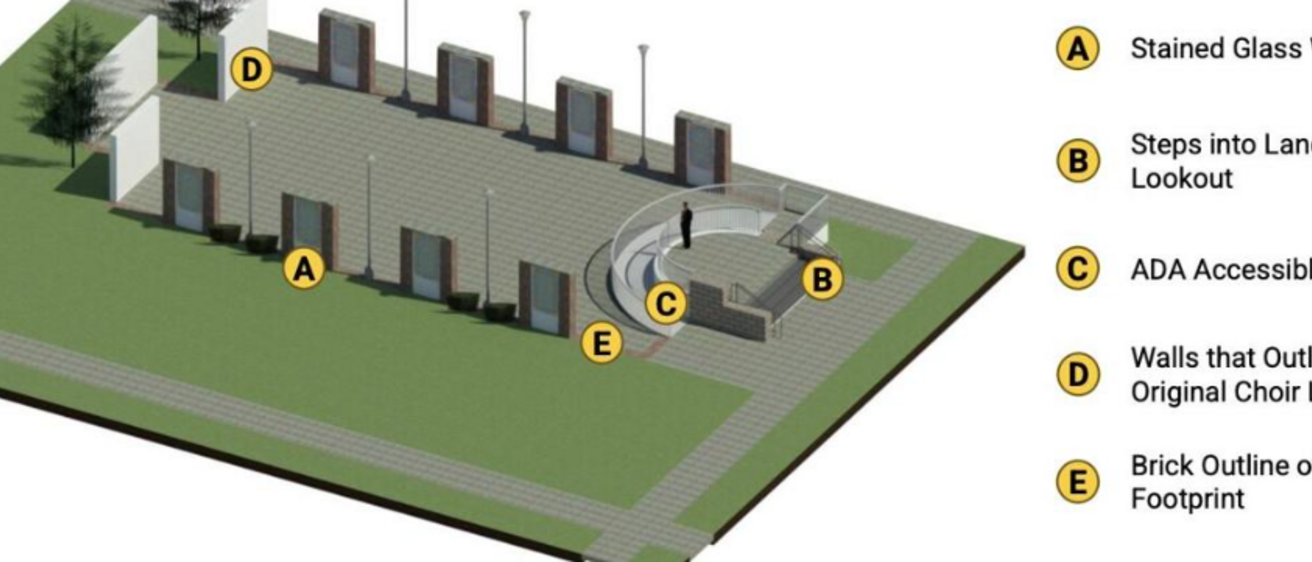
University of Iowa students presented Tuesday to City Council plans to turn the site of the former Bethel AME Church at 303 South Third St. into an open-air memorial.
“The building itself is going to be gone,” Project Manager Samuel Vis said. “But the memory is not completely lost.”
The students of the university’s Civil and Environmental Engineering Department brought to the Council the concept of a site at which the existing steps leading up to the entrance of the church become those of recreated limestone that lead to an ADA-accessible landing from where the memorial in its entirety can be viewed.
“It’s a great opportunity,” Eli Friesen of the university’s team said, “for visitors to feel like they’re still stepping into Bethel AME.”
The walls of the existing building are to be replaced by a one-foot-wide brick outline that borders the site, Vis said, “because even though the physical boundaries of Bethel AME are going to be torn down, you can look on this site and know exactly where it sat.”
The former church’s stained-glass windows are to be taken from the structure’s walls and held by 8-inch concrete column supports in positions similar to where they are now.
Three freestanding walls to display the church’s brick facade are to stand at the rear of the site in an outline of the church’s choir loft.
“This is kind of a bare bones area,” Vis said, “for the community to input memorialization aspects that they deem important.”
The Bethel African Methodist Episcopal church first organized in Clinton in 1866, with Bishop William P. Quinn as part of the Chicago Conference.
Members originally gathered for worship services at the site of the present-day parsonage and put forth fundraising efforts for the building of a church for two years.
In 1969, a church was built at the corner of Third Avenue South and Third Street on property deeded by the Iowa Land Company.
The church’s congregation, over time, dwindled, until few people remained by the 1980s.
On the opposite, south corner of the block, St. John’s Episcopal Church had been constructed at 238 Fourth Ave. South in 1898 according to the designs of architect Josiah Rice. The Bethel church would take its place a year after St. John’s closed in 2006.
Ultimately, the new Bethel church closed during the Covid pandemic, and the church was left for several years in a state of neglect.
On June 28, 2022, Richard Schwab, then-owner of Great Revivalist Brew Lab in Geneseo, Illinois, approached Clinton City Council with a desire to restore the former St. John’s church and turn the properties along South Third Street into a brewery.
The Council unanimously supported Schwab’s vision and, with its 1911 Italian Byzantine mosaic depicting Jesus Christ on the rear wall, conveyed the former St. John’s property to the Downtown Self-Supported Municipal Improvement District II and in July 2022 the original Bethel church property that had been donated to the City in lieu of its demolition to be sold to Schwab.
Renovations to the former St. John’s church began in August 2022, along with the building of a red warehouse situated next to the Vince Jetter Community Center at 311 South Third St.
The brewery, originally slated to be completed in October 2022, opened in May 2023 to distribute by 7G Distributing and Stern Beverage, Inc. craft brews to over 100 locations in Iowa and Illinois.
The establishment garnered national attention, hosting then-presidential candidate Vivek Ramaswamy during his campaign and being featured in 2024 on an episode of “Brewed” as well as America’s Best Restaurants “Roadshow.”
During the same month that the brewery had opened, the Iowa Economic Development Authority awarded the City of Clinton a $100,000 Community Catalyst and Building Remediation Emergency Grant for the building that had housed the original Bethel church.
Holes in the building’s roof, a bowed exterior wall, and delayed visible restoration progress elicited public concern and eventually put the City in a position to lose the grant from the state in May of the following year.
Curt Beason, legal representation for Great Revivalist Brewery, argued at a February 2025 meeting of City Council that approximately $140,000 had been put into bringing power to the building, engineering, and architectural consultation, but the project had come to be larger than anticipated at the time of the grant application.
When initial plans for the building as an entertainment venue failed to attract sufficient interest from developers, Beason said, plans shifted to a model of educational operations due to space constraints.
“We have not been able to find a commercial lender who will loan on this project,” Beason said, estimating the financial shortfall on the $250,000 project to be approximately $100,000 and stating plans to ask the State for additional time.
During that same month, Citizens First Bank petitioned the Court for foreclosure of the brewery. Court documents state that on April 16, 2025, Citizens First Bank was granted a default judgement against defendants Robert Richard Schwab, Great Revivalist Brewing Company LLC, and Great Revivalist Real Estate Holdings LLC in a total amount of $4,580,190.18, plus interest, late fees, and any accruing costs.
The brewery, minus the Bethel property, has since that October become 7 Hills South brewing company.
Grow Clinton hosted meetings beginning in August 2025 about the future of the former Bethel church property. It was then determined that the church was beyond salvage.
The following month, the Gateway History Club—a 501c3 organization—declared to City Council its efforts to assume responsibility for the future of the property with the proposal in a memorandum dated Sept. 18, 2025, that after the completion of the site as a memorial to the former Bethel church, the property would be donated back to the city of Clinton to be maintained as a part of its parks system.
The History Club officially took ownership of the site in January.
An estimate of the total project cost, as presented by the University of Iowa students, comes to $180,448, with the largest expenses being $98,662 for demolition, followed by $25,183 for concrete, and $22,556 for engineering and administration.
City Councilman Gregg Obren, also of the Gateway History Club, said Tuesday that fundraising for the execution of the project is currently in progress.
“Hopefully,” he said, “before too long, we’ll have this project going.”